
Bitcoin Faces a Second Test of $80,000 Support
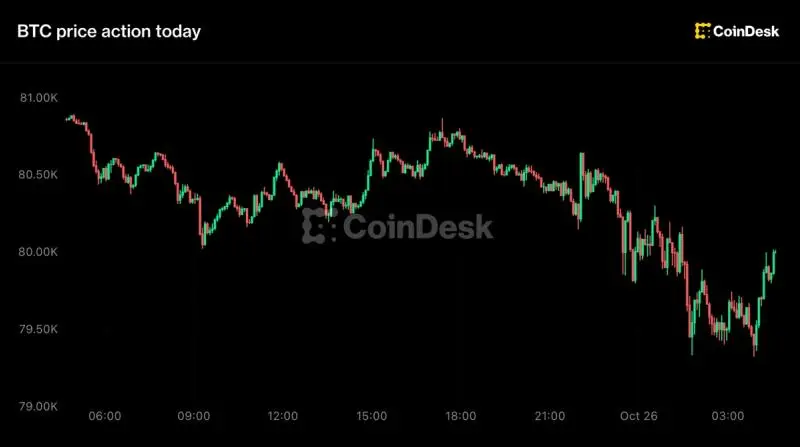
Saturday marked the second major test of Bitcoin’s $80,000 resistance level in roughly ten days. Trading remained in a narrow range around midday, fluctuating between $79,400 and $79,700. The price later recovered above $80,000, but the overall decline over 24 hours reached between 2.3% and 2.5%.
Breaking news
 Bitcoin drops below $80,000 as traders de-risk ahead of Fed meeting
 PancakeSwap Sets Hard Deadline for opBNB CAKE Holders to Bridge Out
 BloomTrading Bot Users Lose $1M in Wallet Drain
 CoinDCX Absorbs $16 Million Loss After Internal Wallet Failure
Leveraged traders were caught off guard by the volatility. More than $810 million in crypto positions were liquidated in a single day. Approximately $689 million came from bullish bets, according to data from Coinglass.com. More than 200,000 traders were liquidated during the same 24-hour period.
Reduced liquidity, typical of weekend trading, intensified the pressure on the market. Once Bitcoin broke below $80,000, forced liquidations accelerated selling in an already vulnerable environment.
Thin Weekend Liquidity Accelerates the Selloff
Peter Schiff, a well-known gold supporter and Bitcoin critic, quickly seized on the move. He said the digital asset was finally collapsing, expressing surprise that its price had remained elevated for so long. Schiff argued that with Bitcoin below $80,000, the next likely destination was $75,000.
He warned that if that support level failed to hold, the weekend would become extremely long for the Bitcoin community. His comments carried particular weight for investors holding exchange-traded funds, who cannot sell their shares until Monday.
The situation highlights a fundamental difference between Bitcoin and the US-listed ETFs that track the physical asset. Bitcoin trades continuously, while ETFs tied to it remain closed on weekends. Investors cannot react to price movements until Monday’s session.
ETF Investors Must Wait Until Markets Reopen
Institutional demand had already weakened considerably. US spot Bitcoin ETFs recorded a net outflow of $635.6 million earlier in the week. BlackRock’s IBIT product accounted for approximately $254 million of that withdrawal, while Fidelity’s FBTC saw $217.5 million in outflows. Another $138 million left the market on October 23.
Bitcoin also fell below its 50-day simple moving average, which sits between $81,700 and $81,800. The move broke through a support level that had held for roughly two months.
Traders are now watching support zones around $78,400 and $77,876. A broader area spanning $76,700 to $72,500 lies further below. Beyond crypto-specific dynamics, weakness in technology stocks and elevated oil prices have complicated the broader outlook.
Technical Support Levels Come Under Scrutiny
Brent crude remained above $117 on Saturday amid Middle East tensions. The move has fueled inflation concerns ahead of the Federal Reserve meeting scheduled for October 27 and 28.
The immediate question is no longer whether Schiff’s $75,000 forecast will materialize. It is whether Bitcoin buyers can regain control of the $80,000 level before ETF investors return to the market on Monday.
Chamath Palihapitiya, who previously predicted Bitcoin could reach $1 million, now argues that artificial intelligence will eventually dismantle Bitcoin’s structure, according to a recent warning.