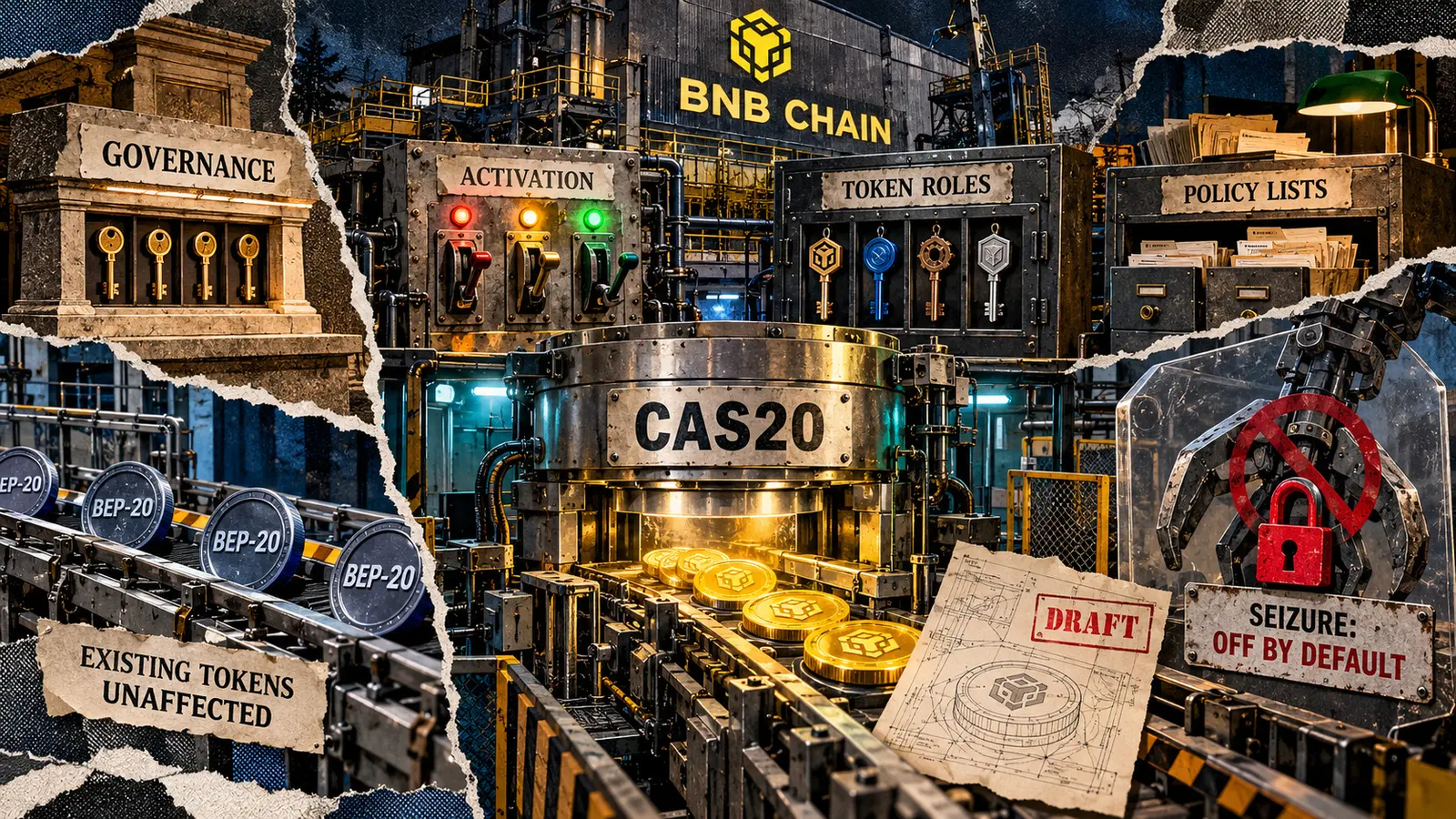
Governance to Control Feature Activation
The Jenner testnet is set to go live at 02:30 UTC on October 29. While a mainnet launch is expected in November, the specific date remains unconfirmed. The proposed BEP-702 standard currently exists as a draft. It focuses on the new CAS20 token family and does not affect existing BEP-20 tokens. This architecture moves common token behaviors into the chain's native logic using stateful precompiles.
Breaking news
 Injective Seeks SEC Approval for Onchain Trading of Tokenized Stocks
 Bitcoin Hits $61,000 as Short Sellers Face $117 Million in Liquidations
 Bitcoin’s Dormant Supply Hits 68.5% as Price Stalls Near $60,000
 Bitcoin ETFs Bleed $3.05B in Seven Days as November Outflows Hit $5.39B
Under BEP-702, chain governance appoints an activation administrator via GovHub, the BSC governance relay contract. This administrator manages separate switches to enable or disable specific features. Only GovHub can change this administrator. The system provides independent controls for creating asset-variant tokens, stablecoin-variant tokens, and writing to the shared policy registry.
Disabling a creation feature stops new CAS20 tokens from being launched. However, it does not freeze existing tokens. Established assets can still mint units, transfer balances, or manage internal roles according to their own permissions. For developers, installing Jenner support and activating token creation are two distinct steps. These switches do not directly freeze or move user balances.
The shared policy registry creates a second layer of dependency. Token administrators select policies for specific operations, while policy administrators manage membership lists. If the registry feature is disabled, membership lists cannot be updated. A user blocked by an existing policy would remain restricted until the registry is reactivated. However, token administrators can still link to other existing policies that are already in the system.
Publisher Permissions Govern Transfers and Seizures
Within a token's internal structure, roles are highly granular. Minting, burning, seizing, and pausing functions use separate permissions. These powers can be held by one entity or distributed across several addresses. Network activation authority, token role membership, and policy administration remain distinct even if managed by the same organization.
Standard transfers check both the sender and receiver against specific policies. Minting also requires the recipient to pass a separate policy check. The seizefunction allows authorized operators to reassign balances without holder consent. However, the default configuration includes protections. The version 1.8.1 administrative code includes a SEIZE_EXEMPT_POLICY.
Accounts authorized under this exemption rule are protected from asset seizure. For a seizure to succeed, the holder must lack exemption. Additionally, the token must have an active seizure role and sufficient balance. When these conditions are met, the seizeWithMemofunction bypasses standard transfer checks. This process reassigns funds while keeping the total token supply unchanged.