Can halting a blockchain truly stop theft?
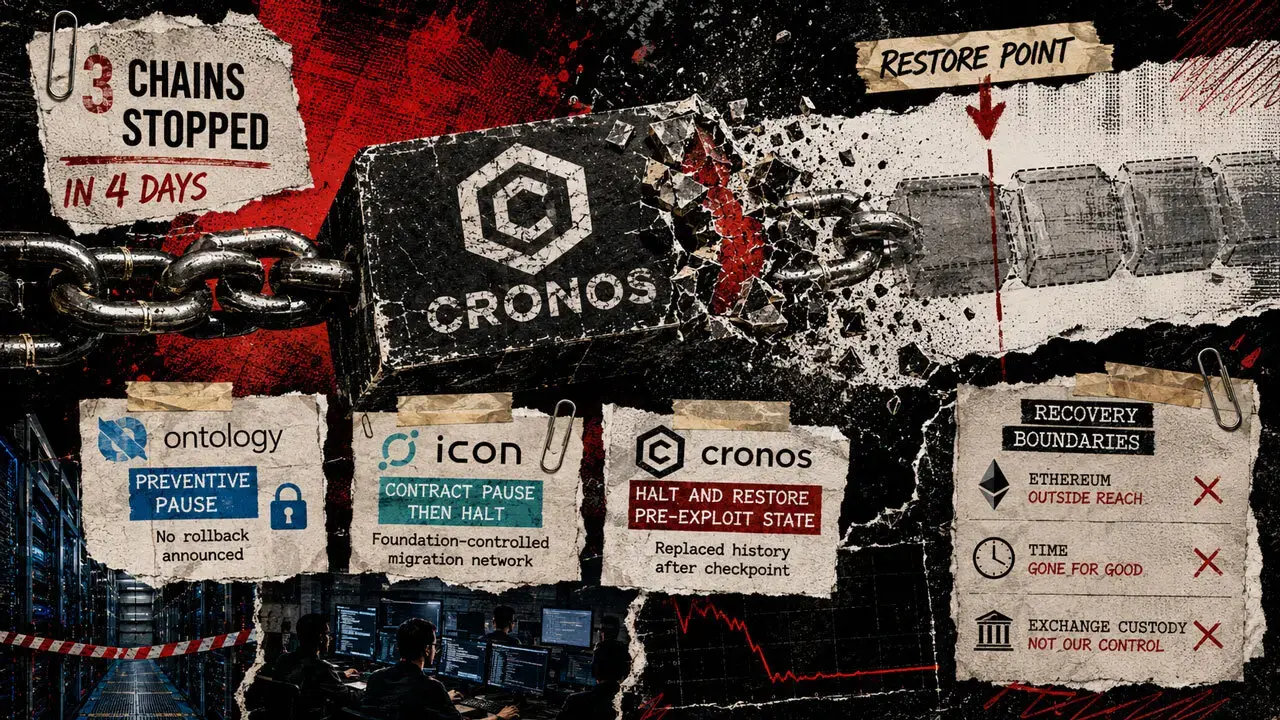
Three major blockchain networks suspended block production within a four-day window as part of emergency responses to security incidents. Cronos, Ontology, and ICON each activated different protocols to stop further damage, with varying degrees of success in protecting user funds. The actions were taken independently by validator groups following detected exploits targeting decentralized finance applications on their respective chains.
Breaking news
 Bitcoin Drops Below $82,000 After Hot US Inflation Data
 Kraken Parent Payward Acquires Saldo Bank for European Expansion
 UK Trader Sues BitMEX Over 1,053 Losing Trades in £20 Million Claim
 EU Banking Regulator Seizes Direct Control of USDC Oversight
Cronos restored its chain to a pre-exploit state after validators agreed to halt the network following an attack on Tectonic, a lending protocol built on the network. By rolling back transaction history, Cronos effectively erased the exploit from its canonical ledger, a move that required broad consensus among validators. Ontology, in contrast, paused block production before any confirmed loss of funds occurred, acting as a preventive measure upon detecting suspicious activity. ICON halted operations only after an exploit had already been executed, aiming to prevent further withdrawals or manipulation while developers assessed the damage.
Unlike Ontology and ICON, Cronos took the additional step of reverting its blockchain to a state prior to the exploit, effectively invalidating transactions that occurred during the attack window. This approach, while rare, is technically possible in networks where validators possess the authority to coordinate state rollbacks through consensus. The decision sparked debate within the community about immutability versus intervention, with some arguing it undermined core blockchain principles while others praised it for protecting users. Validators emphasized that the rollback was only possible due to the timing of the exploit and the ability to achieve near-unanimous agreement.
While stopping block production prevents new transactions from being confirmed, it does not automatically recover funds already moved by attackers before the halt. In cases where stolen assets were transferred to exchanges or privacy tools prior to the network pause, recovery becomes dependent on external cooperation. Ontology’s pre-emptive halt avoided any on-chain loss, but ICON’s post-exploit stop meant that some funds had already been drained. Experts note that network halts are most effective when combined with rapid forensic tracing and coordination with custodial services to freeze assets before they are laundered.
Frequently Asked Questions
Why did Cronos roll back its blockchain instead of just pausing it? Cronos validators decided to restore the pre-exploit state to nullify the effects of the attack, believing it was the only way to fully protect users given the nature of the exploit and the speed of consensus achieved.
Did Ontology lose any funds during its network halt? No, Ontology halted block production before the exploit could result in confirmed losses, meaning no funds were stolen from the chain as a direct result of the incident.
Is it common for blockchains to reverse transactions after an attack? No, reversing transaction history is extremely rare and controversial; most blockchains prioritize immutability, making Cronos’s approach an exceptional measure taken under specific consensus conditions.