What Drove Celestia’s Double-Digit Gain?
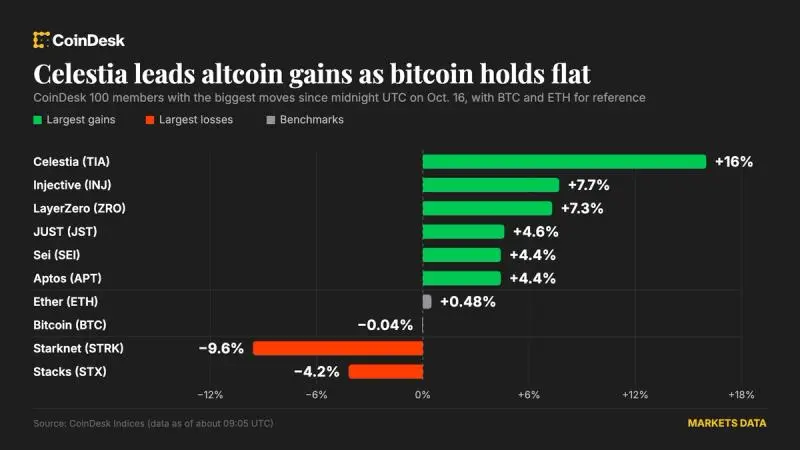
Altcoins outperformed Bitcoin in early trading, with Celestia posting a 16% gain while Bitcoin remained nearly flat around $82,100. Injective rose 7.7% and LayerZero added 7.3% during the same period, highlighting divergent momentum across the crypto market. The moves came as Bitcoin struggled to hold gains after a brief dip to $81,600 earlier in the session. Traders noted the altcoin strength contrasted with Bitcoin’s subdued performance amid lingering uncertainty over U. S. monetary policy.
Breaking news
 Injective Seeks SEC Approval for Onchain Trading of Tokenized Stocks
 Bitcoin Hits $61,000 as Short Sellers Face $117 Million in Liquidations
 Bitcoin’s Dormant Supply Hits 68.5% as Price Stalls Near $60,000
 Bitcoin ETFs Bleed $3.05B in Seven Days as November Outflows Hit $5.39B
The rally in select altcoins coincided with silence from Federal Reserve Governor Michelle Bowman—referred to as Warsh in some reports—on future interest rate decisions, leaving investors without clear guidance on tightening cycles. While Bitcoin showed resilience after rebounding from its intraday low, it failed to break above key resistance levels, suggesting cautious sentiment among larger crypto assets. Market analysts pointed to renewed interest in modular blockchain projects like Celestia, which continues to draw attention for its scalability-focused architecture. Meanwhile, Injective’s rise reflected ongoing demand for decentralized finance infrastructure, and LayerZero’s gain underscored continued confidence in cross-chain interoperability solutions.
How Are Traders Interpreting the Bitcoin-Altcoin Divergence?
Celestia’s 16% surge appears linked to growing anticipation around its upcoming mainnet upgrades and increased developer activity on its modular blockchain network. Recent testnet performance metrics showed improved transaction throughput and lower latency, boosting confidence in its long-term utility. Unlike Bitcoin, which is often viewed as a macroeconomic hedge, Celestia’s price movement reflects more direct engagement with technological milestones and ecosystem expansion. Traders noted that the token’s relative illiquidity compared to Bitcoin can amplify price swings during periods of focused buying pressure, especially when narratives around modularity gain traction in developer circles.
The split performance between Bitcoin and select altcoins suggests a shift toward speculative, theme-driven trading rather than broad risk-on sentiment. While Bitcoin’s stagnation may reflect wait-and-see behavior ahead of potential Fed signals, altcoins like Celestia are benefiting from niche narratives that are less tied to traditional financial markets. Some market observers argue this divergence could indicate early signs of rotation within crypto, where capital flows toward projects with tangible roadmap progress rather than store-of-value narratives. However, others caution that such moves may lack sustainability without broader market participation or clearer macroeconomic cues.
Why did Celestia rise more than Bitcoin? Celestia’s gain was driven by specific project developments and heightened interest in modular blockchain technology, whereas Bitcoin’s price remained constrained by macroeconomic uncertainty and lack of clear directional cues from central bank officials.
Frequently Asked Questions
Is this altcoin rally likely to continue? Sustainability depends on whether the momentum in projects like Celestia, Injective, and LayerZero is supported by ongoing development milestones and broader market engagement, rather than isolated trading spikes.
What role did Fed silence play in the market? The absence of commentary from Fed officials, including Governor Bowman, left investors without new guidance on interest rates, contributing to cautious behavior in Bitcoin while allowing speculative altcoin moves to proceed independently.


