What Factors Are Behind the Altcoin Resurgence?
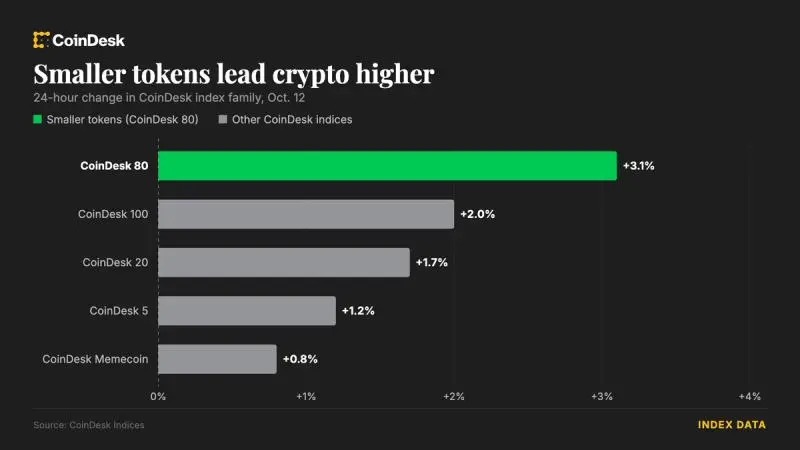
Alternative cryptocurrencies gained momentum in quiet trading conditions on October 12, 2026, while bitcoin remained stuck below the $83,500 threshold. The CoinDesk 80 index, which tracks a broad range of altcoins, rose approximately 3% over the past 24 hours, significantly outperforming the more bitcoin-focused CoinDesk 5 index. This divergence occurred despite continued outflows from spot bitcoin exchange-traded funds, which recorded $681 million in net withdrawals last week. Trading volumes remained notably thin across major crypto exchanges, suggesting limited participation from institutional and retail investors during this period.
Breaking news
 Bitcoin Drops Below $82,000 After Hot US Inflation Data
 Kraken Parent Payward Acquires Saldo Bank for European Expansion
 UK Trader Sues BitMEX Over 1,053 Losing Trades in £20 Million Claim
 EU Banking Regulator Seizes Direct Control of USDC Oversight
The altcoin advance appears driven by speculative buying in lower-cap tokens amid bitcoin’s prolonged consolidation phase. Market observers note that when bitcoin trades sideways within a narrow range, traders often rotate into altseeking higher volatility and potential returns. The CoinDesk 80’s gain of roughly 3% contrasts sharply with the CoinDesk 5’s more modest increase, highlighting the uneven performance across the crypto spectrum. Spot bitcoin ETFs, which had attracted substantial inflows earlier in the year, faced sustained pressure as investors questioned near-term price catalysts for the leading cryptocurrency. Analysts suggest the ETF outflows reflect profit-taking and a wait-and-see approach ahead of potential macroeconomic triggers.
How Long Can This Altcoin Strength Last?
The rally in alternative coins stems from a combination of technical positioning and shifting risk appetite. With bitcoin failing to break above key resistance levels, momentum traders have sought opportunities in ethereum, solana, and various layer-2 tokens showing relative strength. On-chain data indicates increased activity in decentralized finance protocols and meme coin markets, areas typically sensitive to shifts in speculative sentiment. Meanwhile, low trading volumes have amplified price moves, meaning even modest buying pressure can produce outsized gains in thinly traded assets. Some analysts caution that such moves may lack sustainability without broader market participation or a clear catalyst from bitcoin’s price action.
The durability of the altcoin rebound hinges largely on bitcoin’s next move. If bitcoin remains range-bound below $83,500, altcoins may continue to benefit from relative strength trading as investors seek yield elsewhere. However, a sharp downturn in bitcoin could trigger widespread risk-off sentiment, dragging altcoins down with it despite their recent gains. Conversely, a decisive break above $85,000 for bitcoin might renew confidence across the entire crypto market, potentially lifting all boats. Market participants are watching for clues from upcoming U. S. inflation data and Federal Reserve commentary, which could influence risk appetite broadly. Until then, thin trading conditions are likely to persist, making the market susceptible to sudden shifts in direction.
Why did altcoins rise while bitcoin stayed flat? Altcoins rose due to speculative rotation and thin trading conditions that amplified small buying moves, while bitcoin lacked upward momentum despite holding above key support levels.
Frequently Asked Questions
What caused the $681 million outflow from spot bitcoin ETFs? The outflows reflect profit-taking and cautious investor sentiment as bitcoin struggled to gain traction above $83,500, prompting some to reduce exposure temporarily.
Can altcoins continue rising if bitcoin doesn’t break higher? Altcoins may see further gains in low-volume environments, but sustained strength typically requires bitcoin to establish a clearer trend to support broader market confidence.

