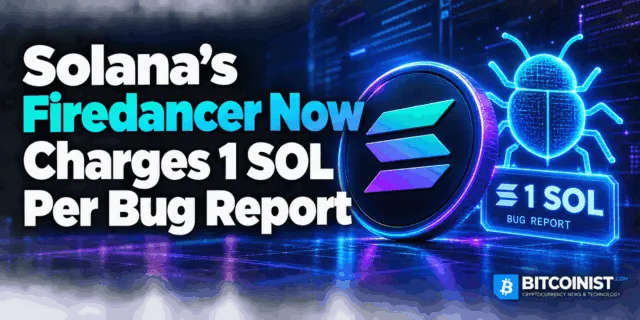
Firedancer imposes 1 SOL fee per bug report
The development team behind Firedancer, a validator client built by Jump Crypto, has introduced a new economic barrier for security researchers. From now on, every vulnerability report must be accompanied by the burning of 1 SOL, worth approximately $100, to be considered. This measure directly targets the flood of AI-generated reports suffocating the reward program.
Breaking news
 Ripple Deepens Ties With Robinhood And BNY For Stablecoin Access
 Robinhood Integrates Ripple RLUSD Stablecoin and Treasury Tools
 Lightning Network tightens invoice rules after exploit exposed
 Major tech giants challenge OKX-ICE tokenized stock plans
The burned tokens are permanently removed from circulation, according to terms updated on Monday. The cost is non-refundable, regardless of whether the report proves invalid, out of scope, or duplicated. Most reports submitted without this fee have no right to a reward.
What is Firedancer and why it matters
Firedancer was built by Jump Crypto as an alternative to Agave, the main software used by validators to verify and process transactions on the Solana network. A critical error in this code could prevent validators from processing payments or cause account balance discrepancies, disrupting transactions and transfers across the network. Every hour spent sorting duplicate or irrelevant reports is a lost hour that could have been used to fix real vulnerabilities.
This decision follows an audit contest with total prizes of $1 million, held between April 9 and May 9. The contest collected 809 reports from 162 researchers, but yielded only 127 unique security findings after removing non-exploitable observations. Nearly half of the valid submissions were duplicates. Jump believes AI agents contributed to the discovery or drafting of almost all submissions.
The flood of AI-generated reports
In an analysis on October 16, Ishan Bhatt from Jump argued that AI has made finding errors cheap, but evaluating them remains expensive. Engineers had to reproduce each issue and verify if the proposed attack actually worked. Some reports signaled apparent weaknesses, ignoring existing protections elsewhere in the code. The stack of unreviewed reports peaked at 299 open reports. As verification slowed, other researchers rediscovered errors already submitted but not yet fixed or disclosed. Approximately 80% of duplicates appeared more than three days after the original report.
Bigger rewards for Alpenglow bugs
The previous contest already imposed a $100 fee per submission and limited researchers to one report per day. Jump argues that imposing a fee discourages submitting a large number of speculative findings. The new platform also limits each main section of the report to 3,000 characters.
Alongside the new fee, Jump is also increasing payouts. Eligible discoveries receive double the standard reward until November 20, while bugs specific to the Alpenglow voting system, Solana's new voting mechanism, receive triple. A critical bug in Alpenglow can earn up to $300,000. This move illustrates how AI is transforming crypto security work: automated tools generate reports faster than humans can analyze them, so teams now use economic costs to filter out the noise.